Saturday, March 8, 2014

So you've decided to visit Hong Kong...


Here's what you need to know!  Hong Kong is a very easy city to live in, and it is a good combination of east meets west, but there are some things that are different.  Not bad, just different.  Here's a heads up on some of those little things that'll help ease you right in when you come to visit us (hint, hint). Disregard my poorly spaced/aligned pictures and text, they are giving me too much grief and I give up.

Trains, Planes and Automobiles

Let's start off with getting around.  Transportation is something that HK does extremely well; best airport for ease of use and efficiency (never a line at security or passport control!), a fast, clean and cheap subway system, an abundance of double decker bus lines, mini-buses galore, ferry lines, and a cheap taxi always within sight.  The most useful thing for you to have always on you at all times is the Octopus Card:


You beep this card to pay for every kind of transportation (except taxis), but you can also use it all over town to pay for food at restaurants, coffee shops, convenience stores, etc.  It's also how we get into our apartment building.  We've got your cards all loaded up and ready for you to use.  Don't leave home without it.

It's also good to know that due to the British colonization of HK up until 1997 they drive on the left side of the road, so watch out when crossing the street, but on the busiest roads they have painted on reminders of which way to look first to watch for cars.  When walking around town, the sidewalks and train stations can be crowded and people don't care as much about personal space. You'll get jostled or cut in front of, or almost have head-on collisions, don't even try to walk more than two people abreast.  Don't stand on the left side of the escalator (that's for people who want to walk up or down) or moving walkways.  Be assertive, move ahead, take that subway seat fast, don't worry if you bump into somebody, no one is going to leave a gap for you or wait for you to go first.  They don't do it to be rude, and they won't think you're rude.  It's just how it goes in a densely populated city.


HK people are in a hurry (except I always manage to find slow pokes to walk behind so maybe I'm the one in a hurry) and you may not know it, but this is the most important button in the elevator:


If you are closest to the buttons in the elevator, it is your job to hit this button as soon as possible when someone gets off in order to shave off that half second of time to keep the elevator moving faster.  We've gotten so accustomed to this, that now we do it every time and so do the kids.

Lost in Translation

What about the language?  Sure, knowing Cantonese would be useful, but thanks to the British invasion, English is widely used.  HK prides itself on being an international city and most people are bi-lingual or tri-lingual; it's actually quite humbling.  In the main areas of the city you'll see signs, menus, pretty much everything in both Chinese and English.  We haven't learned a large amount of Chinese because of this.  The kids both learn Chinese at school, but they are learning Mandarin (spoken in mainland China) and HK-ers speak Cantonese, so that doesn't help us much either.  The most useful word for you to know is mm-goy (this is my phonetic spelling, nothing official).  It's an all purpose thank you, please, excuse me kind of phrase.  Also useful is jo-sahn, means good morning. 

Let's Eat!

On to eating, yum.  While you can find every kind of cuisine here, of course we'll take you out for some delicious Chinese food.  At a Chinese restaurant here, this is the typical place setting:


There's tea and hot water, but no big glass of ice water.  The tea has the tea leaves freely floating in the tea pot so the tea in your cup will be chunky style, but the leaves settle to the bottom just fine.  Much of the time water served at restaurants (Chinese or otherwise) is hot or warm water, occasionally it'll be cold.  We've been told it's because cold water disrupts digestion, cold water makes women gain weight, cold water hurts people's teeth, and warm/hot water means the water has been boiled (so safe to drink).  As a side note, the water here is totally safe to drink and we've been drinking it out of the tap for the past year, but my team at work gasped when I told them this and think we're crazy. 

Of course there are chopsticks, but don't sweat it, every restaurant that we'll take you to does have forks upon request.  Meals are served family style, rarely does each diner order their own entrĂ©e (in Chinese restaurants anyway).  Unlike home, most people don't use the plate (which isn't very big either) to hold the food.  Instead the small bowl with the spoon it sits on top of your plate and you dish small portions into that and eat from there.  The plate is used for holding the spoon, or for holding the things you don't eat like bones or fatty bits, something you decide you don't like, etc.  It's portion control at it's finest since you can't fit a lot in a tiny bowl.  It's hit or miss if the restaurant provides napkins or not, people bring their own.  And while napkins are not guaranteed, strangely, toothpicks are guaranteed and everyone uses them at the end of the meal while artfully covering their mouth with one hand while doing it.

What Not To Wear

Really, there's nothing you shouldn't wear, you'll see it all here.  HK-ers are pretty eclectic with their style and you'll see some interesting combinations.  If its "winter" (temps in the 50's and 60's), the locals break out puffy down jackets, some fur, big sweaters, etc. and act like it's below freezing.  In spring/summer/fall, for women you'll see lots of dresses and skirts (usually short), leggings, skinny jeans.  They seem to love lace, bows, ruffles, textures and lots of things in blush/taupe/nude color or black.  Also short heeled pumps or flats with flair.  More of a feminine style.  I really wanted to take pictures of people, but was too chicken so here are some off the internet:


For the guys, the younger men dress more metro and fashionable than the US, for older men, it's pretty similar to other old men around the world.


So just close your eyes, reach into your closet and grab whatever and stuff it in your suitcase.  Doesn't match? You'll fit right in!


HK-ers love to shop and there is no lack of retail space here.  The malls are packed all the time, like Black Friday year round in some of the most popular spots.


Other Interesting Tidbits

Other miscellaneous things to know...  Light switches are opposite from the US, down for on, up for off.  You are welcome to use your umbrella both to keep off the rain and the sunshine.  I like that I can bring my own shade on a hot day and not feel like a dork.


Hong Kong is highly civilized with usually nice bathrooms stocked with TP, but every once in a while you'll run into a squatty potty in a public park or porta potty at events, or really old restaurant.  I hate them, obviously, but Esme thinks they're a hoot.   Bring your own TP in for these ones, they don't come with frills. 

HK is full of Filipina and Indonesian domestic helpers.  On the weekends, particularly Sunday when most are off, they gather in very large groups in public places for socializing, picnicking, dancing, etc.  Sunday can be a very crowded day to get around.


When you stay with us you'll meet our Filipina helper, Jelyn.  She'll make you feel at home (more like at a hotel), by straightening your room, making your bed, doing your dishes.  She's more reserved and quiet around houseguests and quietly slips around the house.  But she's friendly and kind, good with the kids, and she already told me she plans to make her specialty dessert for you, a mango, graham cracker, sweetened condensed milk combo.

If you're feeling homesick, just walk a block further and no doubt you'll run into one of many U.S. chains, with Starbucks, McDonald's, 7-Eleven and Subway taking the lead.

 
That's it! We'll see you soon!


Saturday, March 1, 2014

Bali: The Halo Bike Tour

Chandra did some research and found that a very popular way to see Bali is via bike tour.   Our tour was run by a locally owned, family-run company called the Halo Bike Tour.   They did a great job!

The tour started with a visit to a garden/shop/faux-plantation that exhibited a lot of the valuable crops grown in Bali.  This includes coffee,  cacao, cloves, cassia, vanilla, peppercorns, ginger, galangal, and a few others I can't remember.


The star attraction of this site is the kopi luwak,  which translates into civet coffee.  The civet is a Asian cat/squirrel/monkey thing that essentially poops gold.


The kopi luwak process works as follows.  The civet is allowed to graze coffee beans on the plantation.   The most attractive beans are eaten by the civet,  enzymes within its system ferments the beans, and then it poops them out.


The beans are then removed from the poop patty and sold at a premium.  Kopi luwak is one of the most expensive coffees in the world,  I shit you not.   You are paying big money for this monkey's fine sense of smell  and his gilded digestive tract.


After we walked the grounds we were able to sit down and try a few of their products.   We paid the extra charge to try the poop coffee.  Here is Chandra with the selection.   The poop coffee got its own special mug.


We liked it but highly question the value proposition of buying an actual bag of poop coffee.  Instead we went for the roselle (hibiscus) tea,  lemon grass tea, and some vanilla beans.


Next stop on the tour was a restaurant overlooking Mount Batur,  an active volcano.   It was a pretty impressive vista.


In the background of this picture is a bigger volcano,  called Mount Agung.   It last erupted in 1963.


The Halo Bike Tour was really well done.   Our tour guide, Sindhu, was knowledgable,  friendly,  and efficient.   He was also great with the kids.


The bike tour is a comfortable,  mostly downhill ride through a few villages and rice fields.  Sindhu and Paul Eli went on a tandem bike while Esme rode on the back of Dad's bike.


The tour really let us see the villages and farming up close.   Here Sindhu is describing the rice harvesting process.


There were tons of sights on the ride.   Here we are overlooking the gathering area of one of the villages.


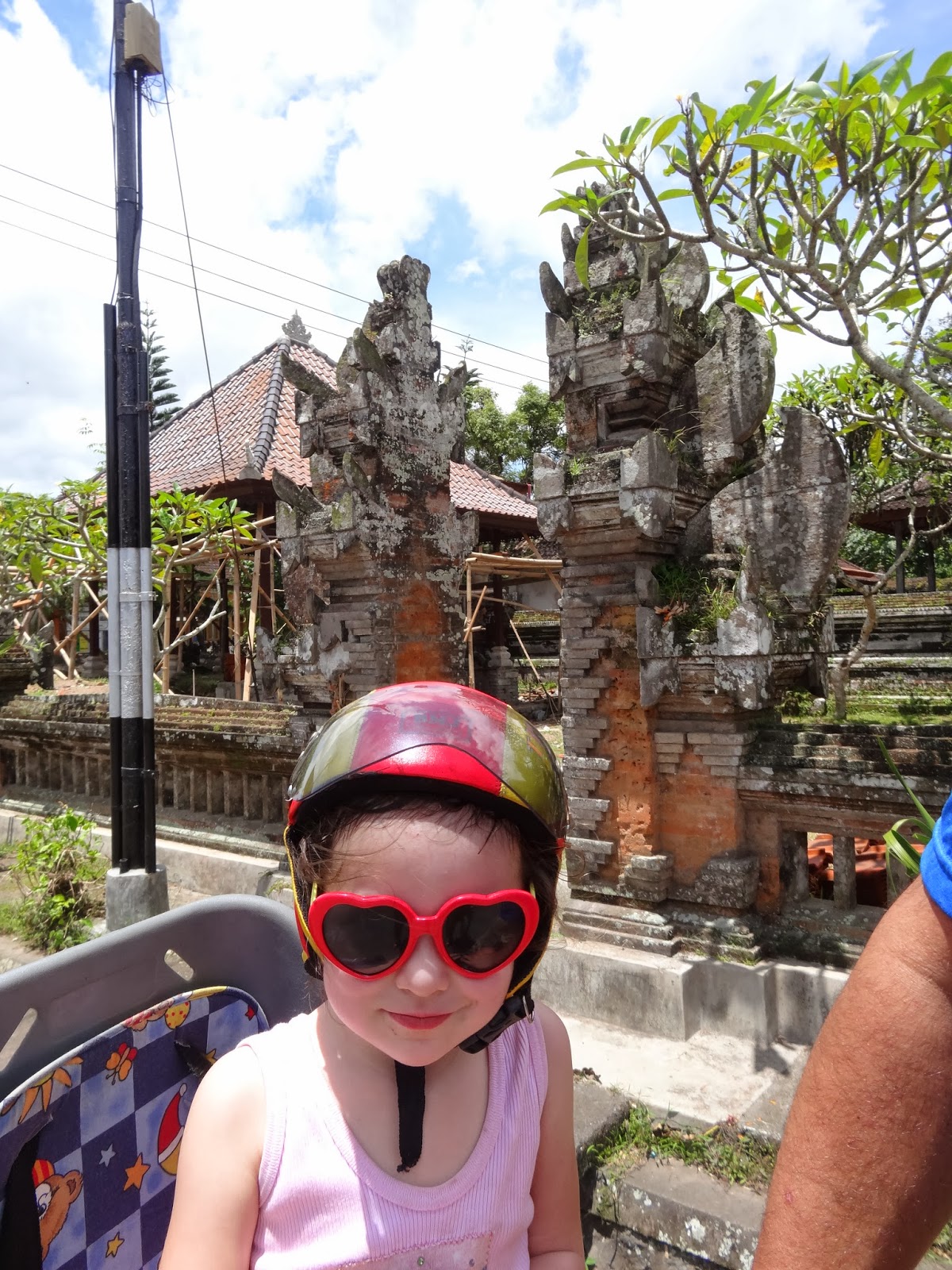
There were many of small temples along the way.


Action shot of Paul Eli.


The last stop of our tour was an authentic home-cooked Balinese meal.   It turns out that the wife of the owner, Yoga,  is a fabulous cook.  This meal was the best food I had on our trip to Bali.   It was simple and complex at the same time.


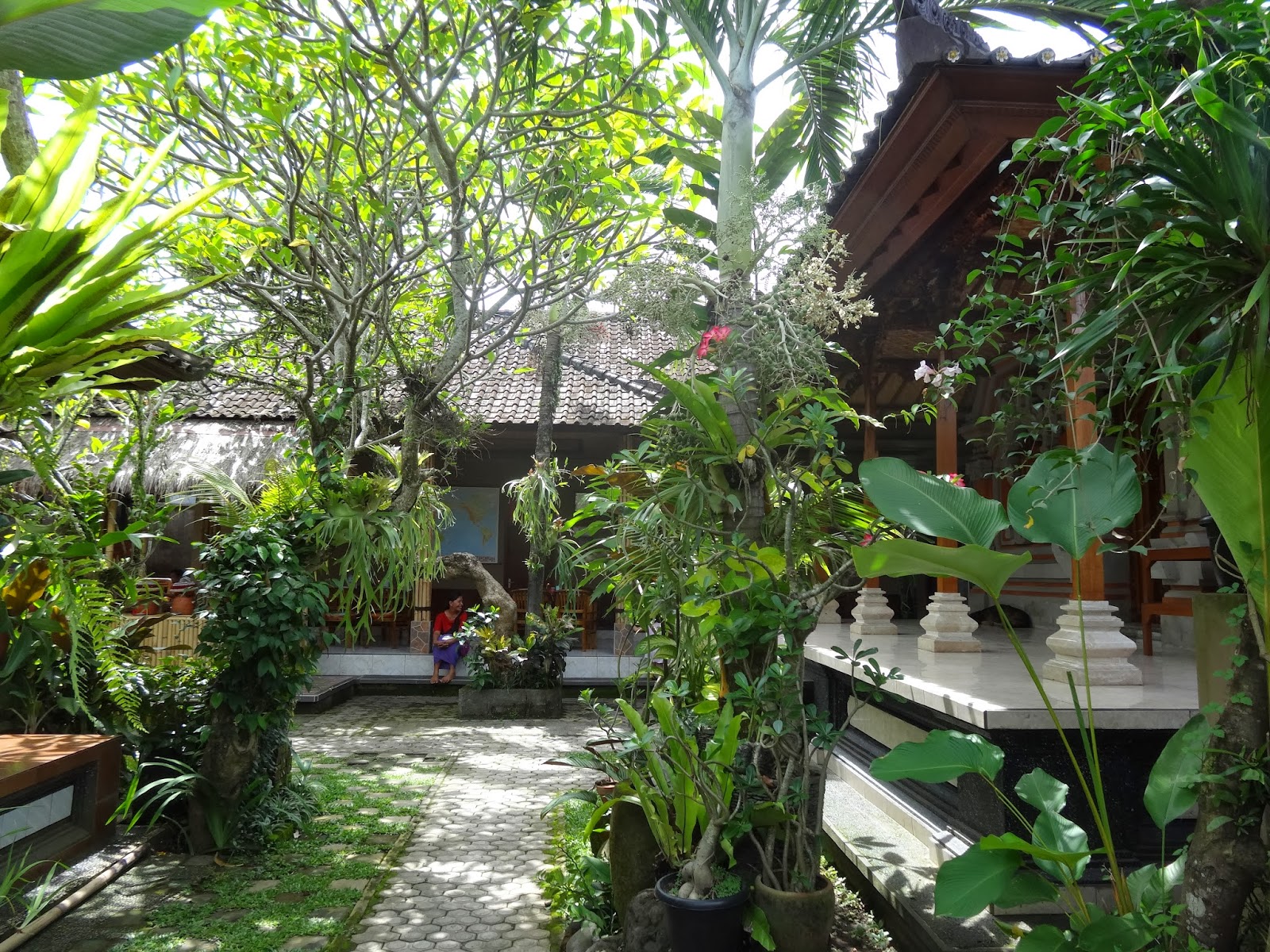
 After our meal we were able to walk around their family compound a bit.   It has been in their family for generations.   They are starting work to offer a bed-and-breakfast type experience.   I think that's a great idea.


 Paul Eli made friends with one of the boys.   Nice background scenery for a mini-soccer pitch, eh?


This is Yoga's family temple.   It is next to their compound.


Hope you enjoyed our little tour through Bali.   If you are ever in the neighborhood, please take a look at Halo Bike Tours!  Esme Stone Sonda approves this message.


Sunday, February 23, 2014

Our first trip to the Southern Hemisphere - Bali!

Bali has been on our bucket list for awhile and we finally made it over Chinese New Year.  It did not disappoint.   Bali is in Indonesia, in the string of islands east of Java,  roughly 5 hours by plane due south of Hong Kong.   That it was mostly south and not much west was a surprise at least to me (Paul).  I guess that's why it is a haven for Australians.


This trip was our longest to date - 5 nights. That gave us enough lazy time to mix with our sightseeing.  We spent the first full day relaxing at the pool and the beach. We stayed at a ritzy hotel in the village of Sanur, right off the beach.    Here's a picture of us enjoying breakfast:


Lunch by the Infinity pool overlooking the Indian Ocean.


Happy hour!  Mom and Dad were downing cocktails while the staff was entertaining Paul Eli and Esme.


 More cute pics of the kids swimming in the beautiful pools.


Esme really made progress with her swimming on this trip.   Here's a short video of her swimming on her own.


OK,  no more hotels and kid pictures,  I promise.  Bali stands out as a vacation destination because it has both beach/weather and culture in significant measures.  Driving up to Ubud,  which is the cultural center of Bali,  you see lots of artisans working on their respective crafts.  Here are the stone sculptors.


I thought it would be cool to send home a super-heavy stone sculpture but we decided against it.


Here is some wood working.


This the impressive grounds of an art museum and gallery.  I would have taken more pictures of the artwork and painters but the host/salesman was all up in my grill trying to get me to buy something.  It must have been my camera that tipped him off that we were big money.


Another cultural highlight in Bali is their version of good vs. evil dance - the Barong keris dance.   Like most things in Bali there was a feeling that all of this performance was done for the tourists,  but we still really enjoyed it.

More poses with Asian women and Esme.   The background is the local community theatre located in "suburban" Ubud (Batubulan).


Accompanying the dance was the local orchestra.   Our guidebook provided some interesting facts about the musicianship.  The recorder (called a Suling) in the lower right is played continuously using circular breathing.   The xylophone type things are actually tuned to be mildly dissonant,  at least by western ears.


This is the Barong.  He is the good guy,  representing order and harmony.


These women danced synchronously.   Their makeup and dancing style was quite interesting.


Paul Eli was pouting because he had had enough culture.   But they jumped into the stands for some audience interaction and it got a smile out of him.


 Our next big stop was the Monkey Forest Sanctuary, a bit of a respite for the children.


The park was set up to protect three varieties of long-tailed monkeys.   They certainly act like they own the place.


 The park was quite nice.   They had other temples within the grounds.


This statue is right next to a beautiful spring at the bottom of a long set of stairs.   This kind of flair is seen everywhere in Bali.


We spent awhile trying to get a monkey to eat a banana out of Paul Eli's hand.   Third take,  we got it but it's kind of underwhelming:


Near Ubud,  we had lunch at a beautiful building overlooking the Wos river valley:


 I didn't take pictures of the food but it was quite nice.  The owner was one of the Big celebrity chefs for local Balinese cuisine.   Of course she was Australian.


On the way back to our hotel we stopped off at a picturesque bridge built by the Dutch oppressors that spanned the river valley.  Unfortunately I didn't get any really nice pictures looking down from the bridge - it looks similar to the view from the restaurant.


 Our last important artisan stop was a teak furniture store to buy some outdoor furniture.   We were kind of flying in the dark - we couldn't get any good recommendations from the hotel or interwebs and the first place we tried wasn't a store at all,  maybe the owner's house?   We finally decided to drive down the main road towards the capital and have the cabbie drop us off when it looked promising.    We like to live dangerously,  but it worked out well...look at all that furniture!


Next post:  a bike tour through a Balinese village and rice fields.